
Developer Hub - Webhooks
Link: https://support.brilliantdirectories.com/support/solutions/articles/12000083005
Overview
Webhooks are one of the methods that allow web applications to communicate with each other. They enable real-time data transfer between applications whenever a specific event occurs.
They also allow data to be sent to any URL endpoint. This makes it possible to send data to intermediary platforms such as Zapier, Pabbly Connect, Workato and APIFuse, to API endpoints on other platforms, or to custom endpoints configured to receive data.
On the website, a webhook event is the action that triggers the data to be sent, such as a form being submitted or a member changing plans. Each event has an on/off switch and a Webhook Link: the full address the data is sent to when the event happens.
Connections and Advanced Settings
To learn how to connect a webhook through Zapier see: Connecting Webhook Events With Zapier
For Smart List webhooks and how to connect them see: How To Create Smart List Webhooks
To include the member login token in outgoing webhook payloads for member-related events (new member registrations, member additions, updates, deletions, and member self-service form submissions), the advanced setting Include Login Token in Member Webhook Payloads must be enabled.
For the fields each webhook sends, see the List of Variables Per Webhook.
Opening the Webhooks Page
- Go to Developer Hub.
- On the Manage Webhooks card, click Manage Webhooks.
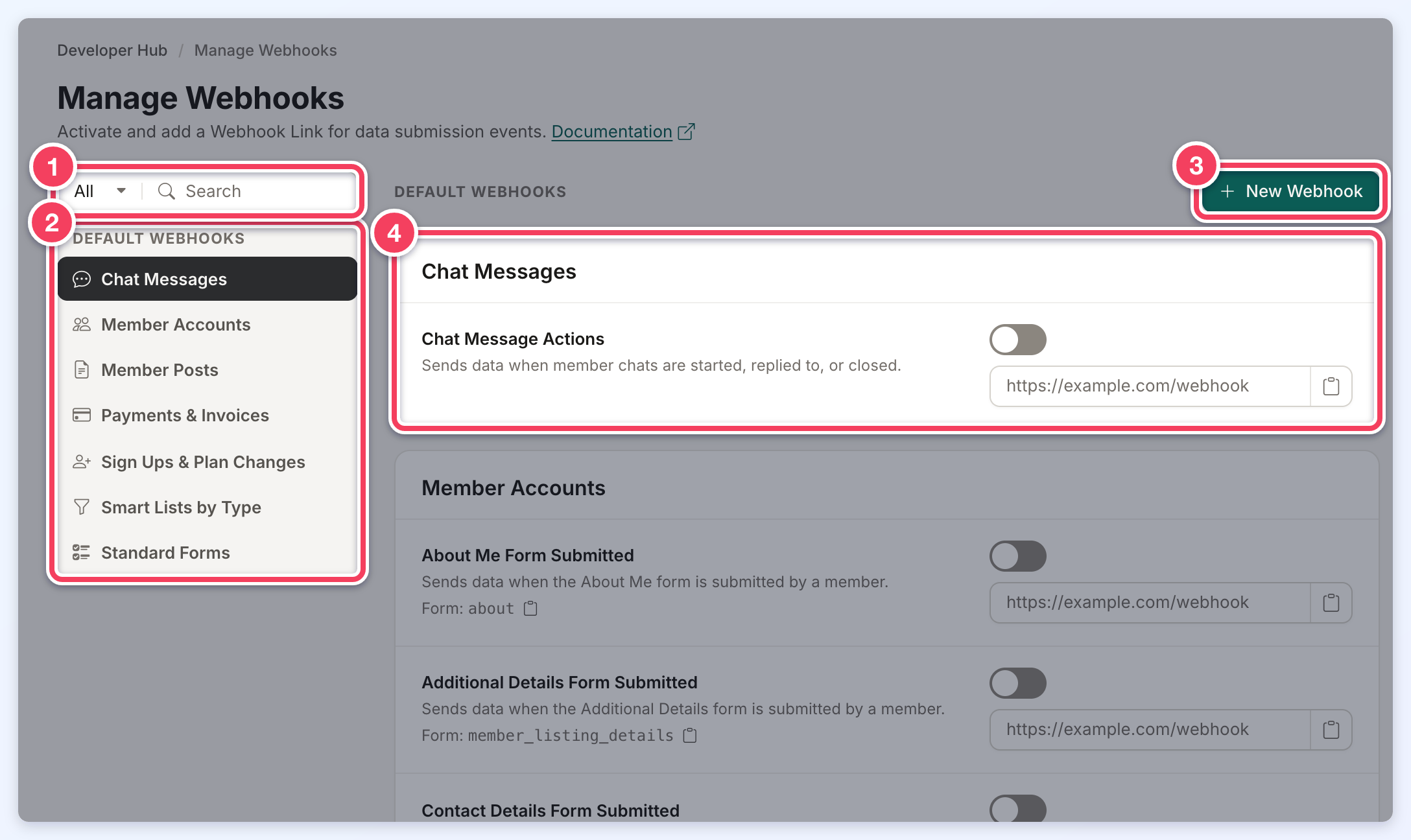
- All / On / Off and Search: the menu shows every webhook, only the ones switched on, or only the ones switched off. The search box finds webhooks by the words typed. While either is in use, a line under the search box counts the matches and offers Clear.
- The section list. Webhooks are grouped into sections under Default Webhooks, and under Custom Webhooks once any custom webhook exists. Clicking a section jumps to it.
- New Webhook: creates a custom webhook for a specific form or Smart List. See How To Create A Custom Webhook.
- A section with its webhooks. Each row shows the event's name, what triggers it and, for form events, the form's name.
Turning a Webhook On

- The switch turns the webhook on or off.
- Webhook Link: the full address (starting with https:// or http://) the data is sent to.
- The copy button copies the Webhook Link. Form events also have a copy button beside the form name.
To turn a webhook on:
- Switch the webhook on.
- Paste the endpoint address into its Webhook Link.
- Click Save in the Unsaved changes bar at the top of the page. Discard in the same bar undoes the changes instead.
A webhook that is switched on must have a Webhook Link. If the link is empty or is not a full web address, the page does not save and shows the problem under the field.
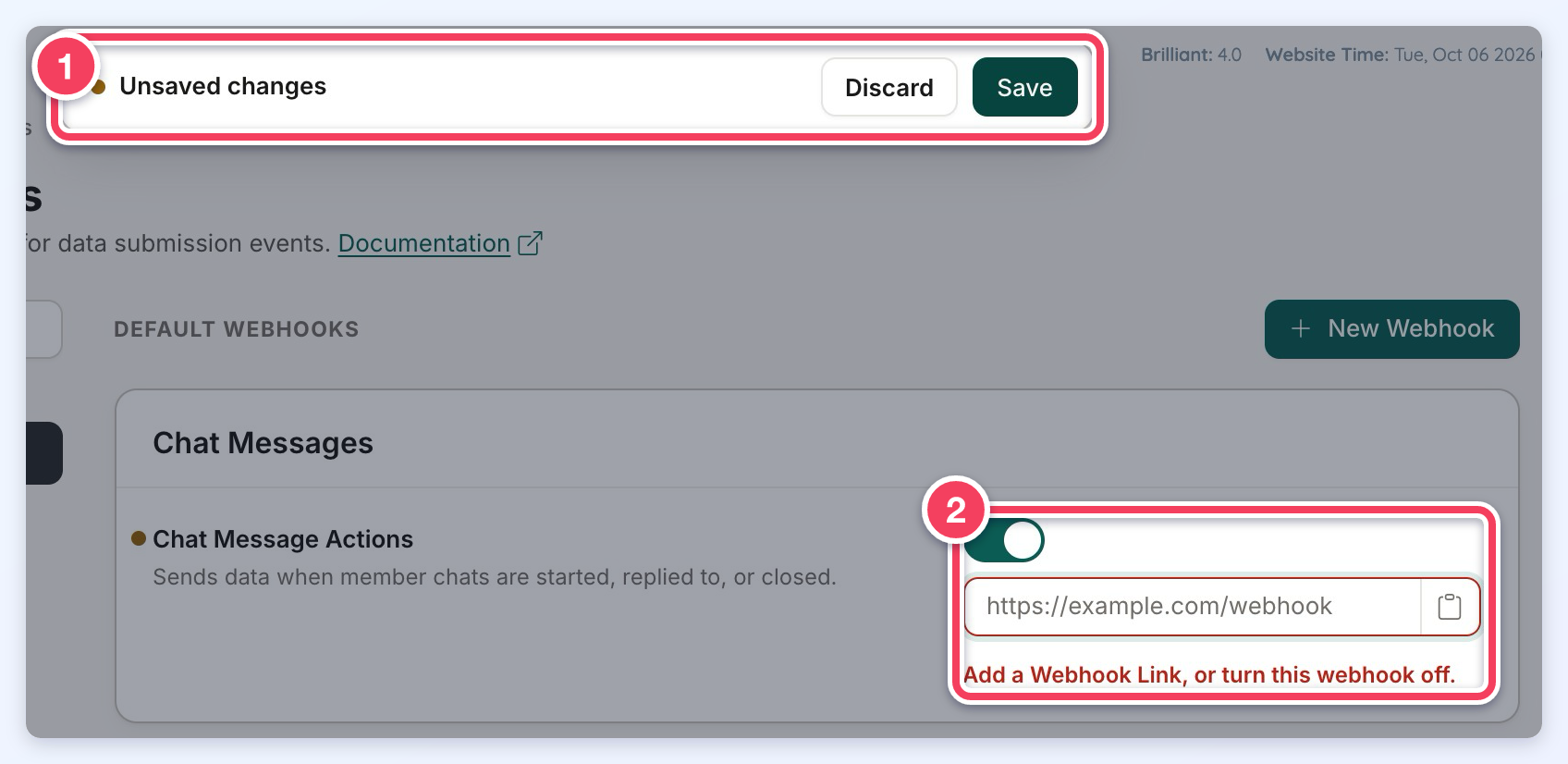
- The Unsaved changes bar, with Discard and Save. A dot also marks each webhook that has unsaved changes.
- A webhook switched on without a link: Add a Webhook Link, or turn this webhook off.
Default Webhook Events
Here is the full list of the default webhooks on the page, by section. Where a form name is shown on the page, it is listed in brackets.
Chat Messages
- Chat Message Actions: a member chat is started, replied to or closed using the Private Member Chat Add-On.
Member Accounts
- About Me Form Submitted: a member submits the About Me form in the Member Dashboard [form=about].
- Additional Details Form Submitted: a member submits the Additional Details form in the Member Dashboard [form=member_listing_details].
- Contact Details Form Submitted: a member submits the Contact Details form in the Member Dashboard [form=member_contact_details].
- Member Accepts / Declines Lead: a member accepts or declines a lead in the Member Dashboard.
- Members Imported / Added / Updated / Deleted Via Admin: a member is imported by CSV file in the Admin, imported with the Instant Business Data tool, added manually in the Admin, updated through the Quick Edit form in the Admin, or deleted in the Admin.
- Profile Photos Form Submitted: a member uploads or edits their profile photo, logo or cover photo in the Member Dashboard.
- Sub-Account Form Submitted: a member creates a sub-account using the Multi-Member Manager Add-On [form=sub_accounts_form].
Member Posts
- Photo Album Post Deleted: a member or admin deletes a post of a Multi-Image Post Type (Photo Albums, Digital Products, Products, Classifieds, Properties).
- Photo Album Post Saved: a member adds or edits a post of a Multi-Image Post Type.
- Post Comment Submitted: a member submits a comment on a post.
- Standard Post Deleted: a member or admin deletes a post of a Single Image Post Type (Videos, Articles, Blog Articles, Jobs, Events, Coupons, Audios, Discussions).
- Standard Post Saved: a member adds or edits a post of a Single Image Post Type.
Payments & Invoices
- Admin Subscription / Invoice Action: an admin creates, updates, cancels or deletes an invoice or subscription in the Admin area.
- Automatic Invoice Payment Succeeded / Failed: the system collects, or fails to collect, a recurring subscription payment during the daily scheduled run.
- Manual Invoice Payment Succeeded / Failed: a member pays a pending or past due invoice from the Member Dashboard.
- One-Time Purchase: a member buys a Lead, a Digital Product or a Pay Per Post credit.
Sign Ups & Plan Changes
- Member Account Cancelled: a member cancels their account from the Member Dashboard.
- Member Plan Changed: a member upgrades or downgrades their Membership Plan in the Member Dashboard.
- Sign Up: Email Verification Link Clicked: a member clicks the verification link sent in the basic-validation email template, typically after signing up for a free plan (email variable %confirm_link%).
- Sign Up: Free Plan: a member signs up for a free Membership Plan on the website [form=signup_free].
- Sign Up: Paid Plan (Off-Site Payment): a member signs up for a paid Membership Plan using an Off-Site Payment Gateway [form=whmcs_signup_external].
- Sign Up: Paid Plan (On-Site Payment): a member signs up for a paid Membership Plan using an On-Site Payment Gateway [form=whmcs_signup_paid].
Smart Lists by Type
These webhooks send the records of every Smart List of that type when Sync Webhook Now is clicked on a Smart List or its schedule runs. To send one specific Smart List to its own link, create a custom webhook for it instead.
- All Form Inquiries Lists
- All Leads Lists
- All Members Lists
- All Reviews Lists
- All Transactions Lists
Standard Forms
- Contact Us Form Submitted: a visitor submits the website's Contact Us form [form=contact_form].
- Get Matched Lead Form Submitted: a visitor submits the Get Matched lead form [form=bootstrap_get_match].
- Member Review Form Submitted: a visitor submits a review for a member [form=member_review].
- Newsletter Form Submitted: a visitor submits the Newsletter Signup form [form=newsletter_modal_signup].
- Unsubscribed Form Submitted: a visitor submits the Newsletter Unsubscribe form [form=unsubscribe_email].
Custom Webhooks
A custom webhook sends the data of one specific form, or of one specific Smart List, to its own Webhook Link. Custom versions of the member forms (EG a copy of the Contact Details, Additional Details or About forms under a different name) and custom forms are connected this way. Custom webhooks are listed under Custom Webhooks, in a Forms section and a Smart Lists section, and each has a menu with Edit and Delete Webhook.
