Manage Your Website's Email Accounts With Office 365
Link: https://support.brilliantdirectories.com/support/solutions/articles/12000014019
Microsoft 365, formerly Office 365, can be used to manage the email accounts for a domain connected to a Brilliant Directories website. This setup is completed by adding Microsoft 365 DNS records to the domain, which tells the domain where email should be delivered and allows Microsoft to verify domain ownership.
Before making any DNS changes, confirm where the domain’s DNS records are currently managed. If the domain is using Brilliant Directories nameservers, the DNS records can be managed from the website’s cPanel account. If the domain is using nameservers from another provider, such as GoDaddy, Cloudflare, Namecheap, or another registrar, the DNS records must be added directly through that provider instead.
Overview
To route domain email through Microsoft 365, the domain must first be added and verified inside the Microsoft 365 admin center. After verification, Microsoft will provide the DNS records needed for email delivery, including records such as MX, CNAME, and TXT records.
The exact DNS values should always be copied directly from the Microsoft 365 admin center. Some values are unique to each domain and Microsoft account, so DNS records should not be copied from another website, another domain, or an outdated support article.
The general setup process is:
- Add the domain in Microsoft 365.
- Copy the required DNS records from the Microsoft 365 admin center.
- Add the records where the domain’s DNS is managed.
- Verify the domain in Microsoft 365.
- Update the MX record so email is delivered to Microsoft 365.
- Test sending and receiving email.
Step 1: Add the Domain in Microsoft 365
Log in to the Microsoft 365 admin center and go to Settings > Domains.
Select the option to add a domain, then enter the website’s domain name without www.
For example, enter:
yourdomain.com
Follow the prompts provided by Microsoft 365. During this process, Microsoft will provide a TXT verification record. This record is used to confirm ownership of the domain before Microsoft 365 can begin managing email for it.
Step 2: Locate the Required DNS Records
Inside the Microsoft 365 admin center, open the domain that is being connected and locate the DNS records area. Microsoft 365 will display the records that need to be added based on the services being used.
For email with Exchange Online, Microsoft commonly requires the following records:
- TXT record: Verifies domain ownership.
- MX record: Routes incoming email to Microsoft 365.
- CNAME record: Helps Outlook and other mail apps connect automatically using autodiscover.
- SPF TXT record: Helps authorize Microsoft 365 to send email for the domain.
Additional records may appear if Microsoft Teams, Intune, Mobile Device Management, or other Microsoft services are being used. Only add the records shown inside the Microsoft 365 admin center for the domain being connected.
Step 3: Open the Domain’s DNS Settings
The DNS records must be added wherever the domain’s nameservers are currently managed. This is an important step because adding records in the wrong place will not update the live DNS for the domain.
If the Domain Uses Brilliant Directories Nameservers
If the domain is using Brilliant Directories nameservers, log in to the Brilliant Directories admin area and go to Settings > Domain Manager. Open the website’s cPanel account, then go to Zone Editor and select Manage for the domain.
This is where TXT, MX, CNAME, and other DNS records can be added or edited.
If the Domain Uses Third-Party Nameservers
If the domain is using nameservers from another provider, the Microsoft 365 records must be added through that provider’s DNS management area instead. This may be the domain registrar or DNS host, such as GoDaddy, Cloudflare, Namecheap, Network Solutions, Squarespace Domains, or another DNS provider.
In this case, do not add the records in Brilliant Directories cPanel unless the domain is actually using Brilliant Directories nameservers.
Step 4: Add the TXT Verification Record
In the DNS editor, add the TXT verification record provided by Microsoft 365. This record is usually added to the root domain, but the exact host/name value may vary depending on the DNS provider.
Common host/name examples include:
@yourdomain.com
After the TXT record is added, return to Microsoft 365 and continue the domain verification process. DNS changes can often verify within a few minutes, but they may take longer to update globally.
Step 5: Add the Microsoft 365 Email Records
After the domain is verified, Microsoft 365 will provide the DNS records needed for email delivery. These records should be copied exactly as shown in the Microsoft 365 admin center.
MX Record
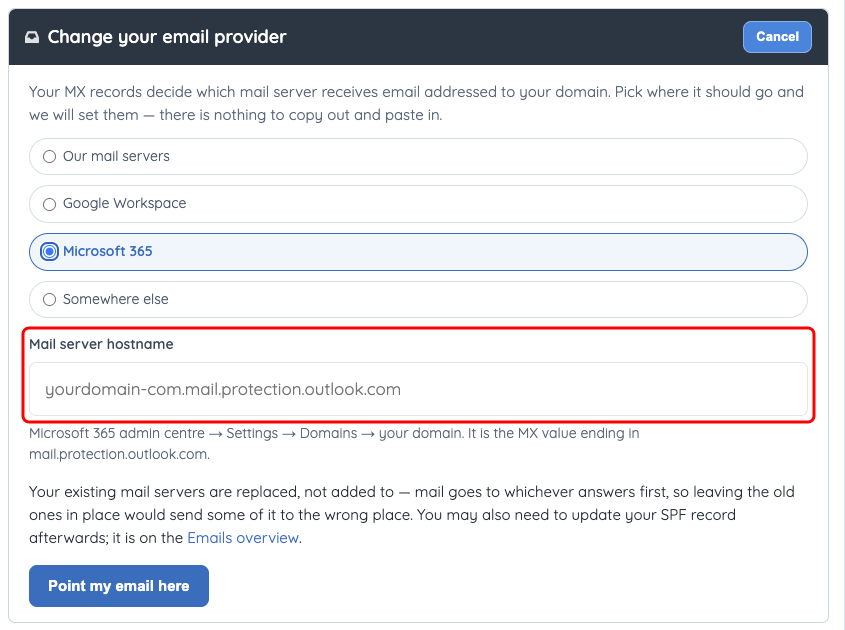
The MX record routes incoming email for the domain to Microsoft 365. This is the most important record for receiving email through Microsoft 365.
Before changing the MX record, make sure the email accounts already exist in Microsoft 365. Once the MX record is updated, new incoming email for the domain will begin routing to Microsoft 365 instead of the previous email provider.
CNAME Record for Autodiscover
The autodiscover CNAME record helps Outlook and other email clients locate the correct Microsoft 365 mailbox settings automatically.
A common autodiscover setup uses:
- Name/Host:
autodiscover - Destination/Value:
autodiscover.outlook.com
Use the exact values shown in Microsoft 365, as the required format may vary depending on the DNS provider.
SPF TXT Record
The SPF TXT record helps identify Microsoft 365 as an approved sender for the domain. Microsoft 365 will provide the recommended SPF value.
A common Microsoft 365 SPF value is:
v=spf1 include:spf.protection.outlook.com -all
Important: A domain should only have one SPF record. If an SPF record already exists, update the existing record instead of creating a second SPF record.
Additional Records
Microsoft 365 may also provide additional CNAME or SRV records depending on the services enabled in the account. These may relate to Microsoft Teams, Skype for Business, Intune, Mobile Device Management, or other Microsoft services.
Only add the records that Microsoft 365 displays for the domain and services being used.
Step 6: Update the Existing MX Record
If an MX record already exists for the domain, edit the existing MX record instead of leaving multiple conflicting MX records in place. Replace the current destination/value with the MX value provided by Microsoft 365, then save the change.
Once the MX record has updated, incoming email for the domain will route to Microsoft 365.
Step 7: Confirm the Records in Microsoft 365
Return to the Microsoft 365 admin center and open the domain setup area. Use Microsoft’s verification or check records option to confirm whether the required DNS records have been added correctly.
If Microsoft 365 shows that a record is missing or incorrect, compare the values shown in Microsoft 365 with the values added in the DNS editor.
Common issues include:
- Incorrect host/name value
- Extra spaces in the record value
- Incorrect destination/value
- Duplicate SPF records
- Old MX records still active
- Records added at the wrong DNS provider
Reference Table: Microsoft 365 DNS Records
The table below includes the Microsoft 365 DNS records referenced in the original Office 365 setup article. These records are provided as a reference only. Always copy the final DNS values directly from the Microsoft 365 admin center, since some records are unique to each domain and Microsoft account.
| Type | Name / Host | Value / Destination | Purpose |
|---|---|---|---|
| TXT | @ or root domain | MS=msXXXXXXXX | Verifies domain ownership in Microsoft 365. |
| MX | @ or root domain | Use the MX value shown in Microsoft 365. | Routes incoming email to Microsoft 365. |
| CNAME | autodiscover | autodiscover.outlook.com | Helps Outlook connect to Microsoft 365 mailboxes automatically. |
| TXT | @ or root domain | v=spf1 include:spf.protection.outlook.com -all | Authorizes Microsoft 365 to send email for the domain. |
| CNAME | lyncdiscover | webdir.online.lync.com | Supports Skype for Business / Lync discovery. |
| CNAME | msoid | clientconfig.microsoftonline-p.net | Supports Microsoft Online identity services. |
| CNAME | sip | sipdir.online.lync.com | Supports Skype for Business SIP services. |
| SRV | _sip._tls | sipdir.online.lync.comPriority: 100Weight: 1Port: 443 | Supports secure SIP service for Skype for Business. |
| SRV | _sipfederationtls._tcp | sipfed.online.lync.comPriority: 100Weight: 1Port: 5061 | Supports Skype for Business federation. |
| CNAME | enterpriseregistration | enterpriseregistration.windows.net | Supports Microsoft device registration services. |
| CNAME | enterpriseenrollment | enterpriseenrollment-s.manage.microsoft.com | Supports Microsoft device enrollment / MDM services. |
Note: Some Microsoft 365 accounts may not require every record listed above. Add only the records shown inside the Microsoft 365 admin center for the domain and services being used.
Troubleshooting
Microsoft 365 Cannot Verify the Domain
Confirm the TXT verification record was added where the domain’s DNS is actually managed. If the domain is not using Brilliant Directories nameservers, adding the record in cPanel will not update the live DNS.
Email Is Not Being Received
Check the MX record and confirm it points to the Microsoft 365 value provided inside the Microsoft 365 admin center. Also confirm that the email mailbox already exists in Microsoft 365 before testing delivery.
Outlook Is Not Connecting Automatically
Check the autodiscover CNAME record. The host/name should commonly be autodiscover, and the destination/value commonly points to autodiscover.outlook.com. Use the exact values shown in Microsoft 365.
Microsoft 365 Shows an SPF Error
Confirm the domain only has one SPF TXT record. If another SPF record already exists, combine the needed values into one SPF record instead of adding a second SPF record.
Records Were Added in cPanel but Nothing Changed
This usually means the domain is not using Brilliant Directories nameservers. Check the domain’s nameservers to confirm where DNS is managed. If the domain is using a third-party DNS provider, the Microsoft 365 records must be added there.
Important Notes
- Brilliant Directories does not manage Microsoft 365 mailboxes, Microsoft billing, Microsoft passwords, or Microsoft account access.
- Microsoft 365 controls the email hosting service.
- Brilliant Directories only provides access to DNS management through cPanel when the domain is using Brilliant Directories nameservers.
- Always copy the DNS values directly from the Microsoft 365 admin center for the domain being connected.
- Do not use sample DNS values unless Microsoft 365 shows the same values for the account.